
Last updated September 22, 2026
Level 1 sweep and inspection to the NFPA 211 annual standard - flue, crown, cap, and flashing checked and photographed
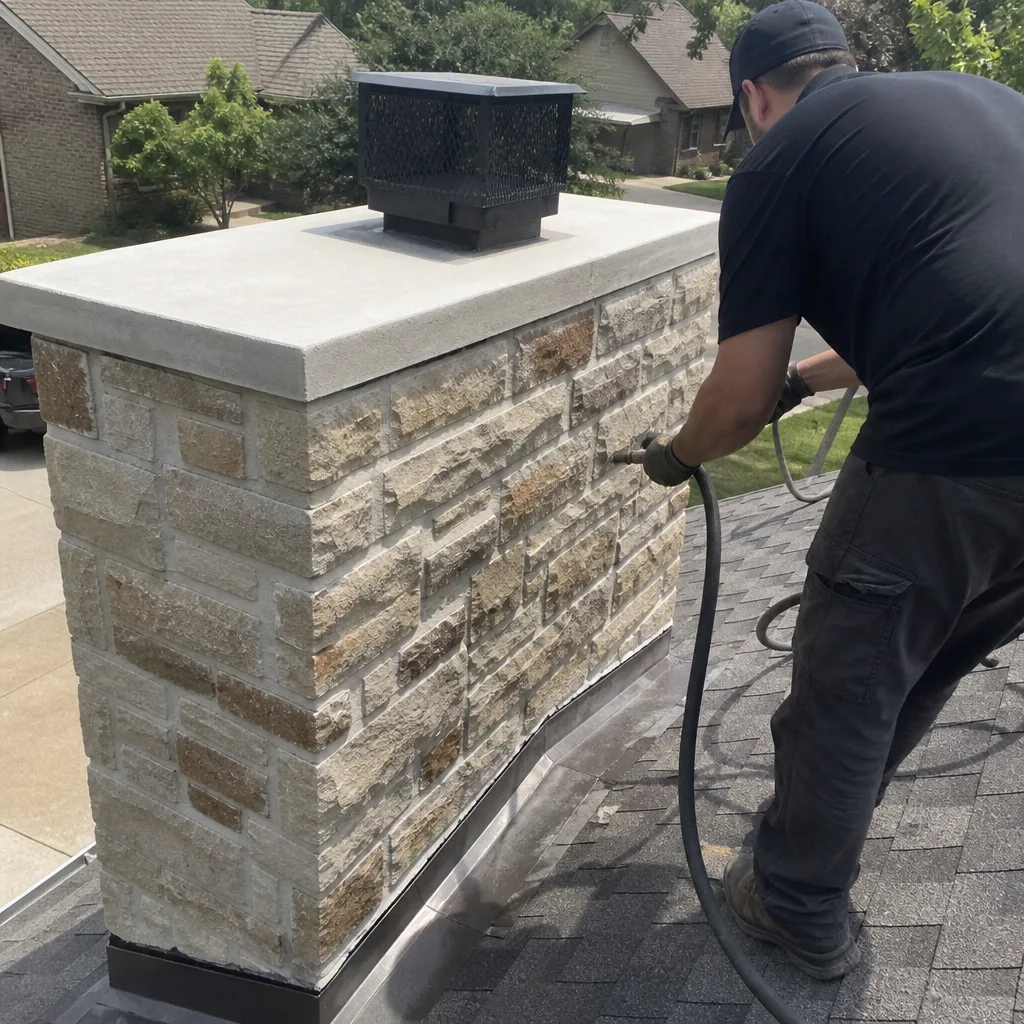
Chimney sweep logs do not sweep chimneys. They loosen some creosote - which then falls where a brush and vacuum still have to collect it.
Masonry repairGas fireplace service
 Before
 After
After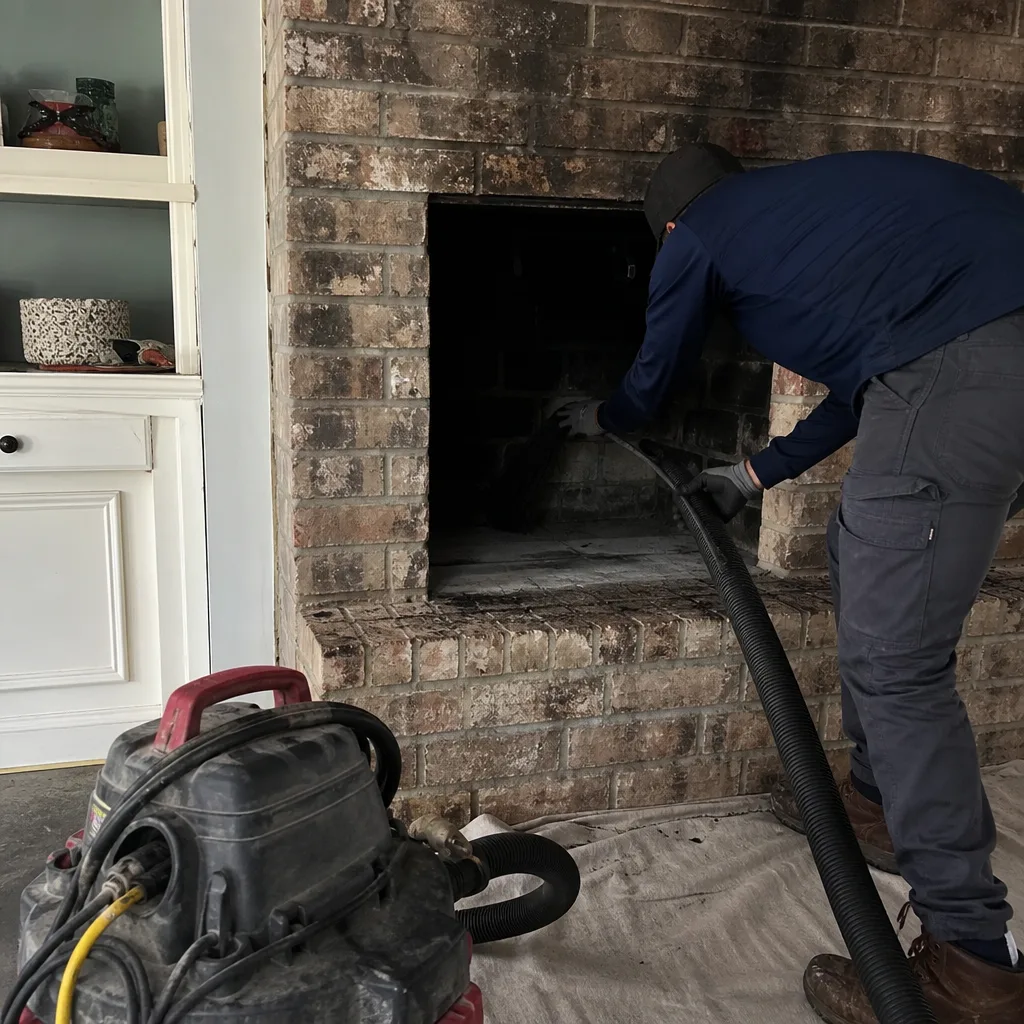 Before
 After
After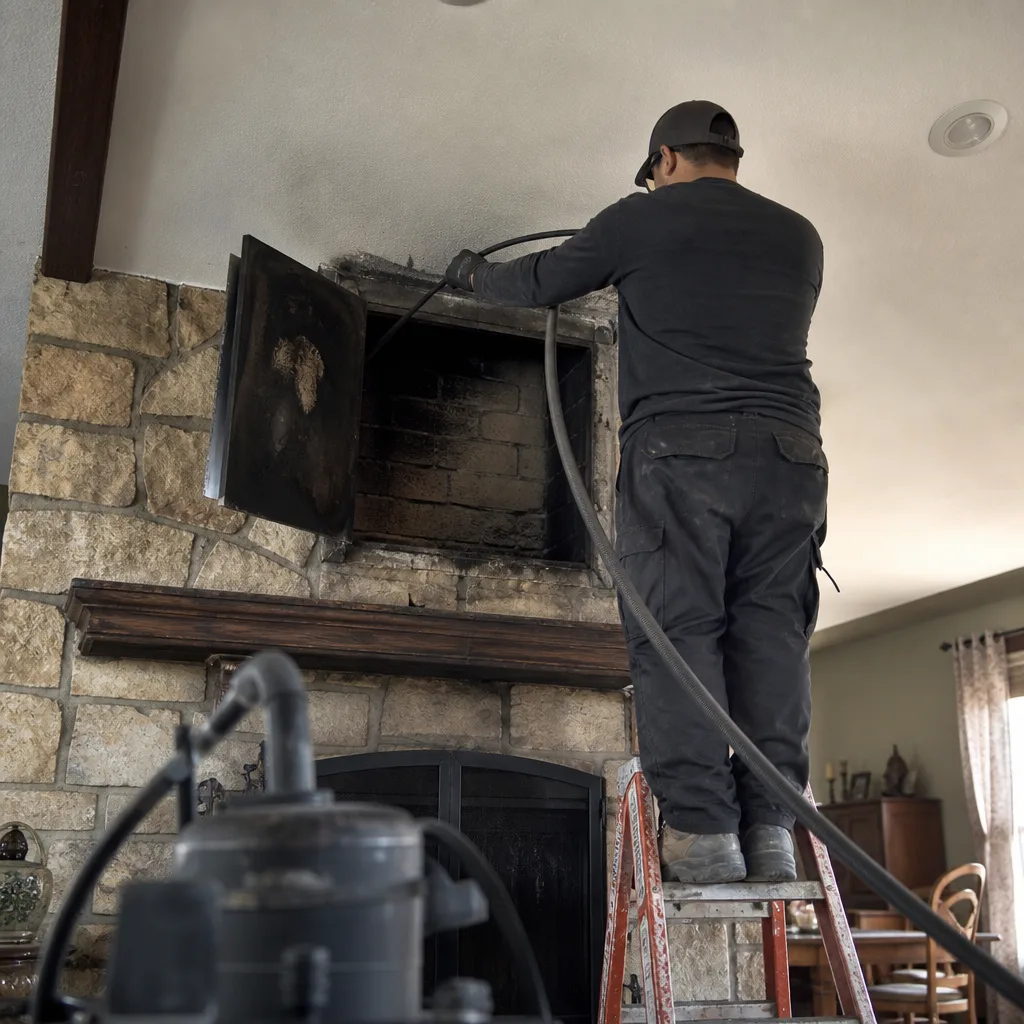 Before
 After
AfterDIY vs Professional Chimney Cleaning: The McKinney Homeowner’s Decision Guide
Here’s something most McKinney homeowners don’t realize: you can legally sweep your own chimney in Texas, buy the correct brushes, and do a competent job removing first-degree creosote - and your insurer can still deny a fire claim if you can’t prove the liner was intact before the fire. The DIY versus professional debate isn’t really about whether you can push a brush up a flue. It’s about whether you can produce the documentation that matters when something goes wrong. In this guide - and across our more guides & resources - we’ll show you exactly what a competent homeowner can accomplish with store-bought tools, what requires professional equipment you can’t rent at Home Depot, and why the camera record, written assessment, and transferable warranty are the real dividing lines.
Quick Answer
A homeowner in McKinney can safely handle basic fireplace maintenance like gas glass cleaning, cap debris removal, and firebox ash cleanup. For anything involving the flue liner, smoke chamber, or post-storm assessment, professional service is necessary because the critical defects that cause fires are invisible without a camera inspection. A documented Level 2 inspection with timestamped photos and written warranty is what insurers and home buyers actually require.
Table of Contents
- What DIY Chimney Cleaning Can Actually Accomplish
- What You Literally Cannot See Without Professional Equipment
- The Documentation Divide: Why Insurers Care More Than You Think
- McKinney-Specific Scenarios: When DIY Makes Sense and When It Doesn’t
- The True Cost Comparison: Equipment vs. Professional Service
- Safety Realities: What the NFPA 211 Standard Actually Requires
- Common Mistakes to Avoid
- When to Call a Professional
- Frequently Asked Questions
- The Bottom Line
 Before
 After
AfterWhat DIY Chimney Cleaning Can Actually Accomplish
Let’s be precise about what “DIY chimney cleaning” means. A motivated McKinney homeowner with $150 in equipment and a Saturday morning can accomplish three things competently: firebox debris removal, accessible smoke shelf brushing, and exterior cap cleaning. That’s the full list. Everything else either requires tools you can’t buy at a retail store or produces documentation you can’t generate yourself.
Here’s what each task involves and where the limits sit:
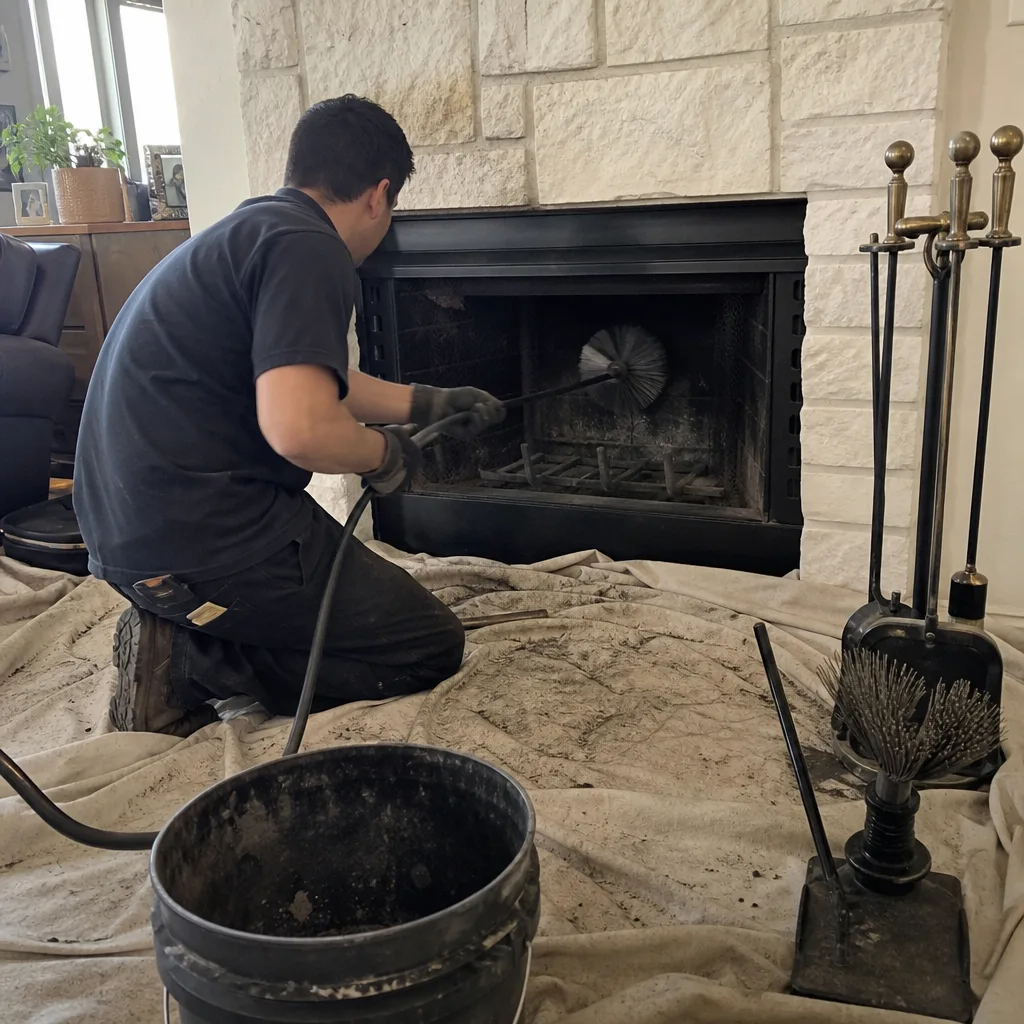
- Firebox debris removal. This is straightforward ash and soot cleanup using a fireplace shovel, metal bucket, and shop vacuum with a HEPA filter. Important: the ash must be fully cooled (72 hours minimum) and the vacuum must be rated for fine particulate. Standard household vacuums will blow alkaline ash through the motor and into your living room. We see this mistake in Adriatica and Stonebridge Ranch every fall - homeowners who thought they were being thorough and ended up with a white film on every surface.
- Accessible smoke shelf brushing. The smoke shelf sits behind the damper and collects fallen debris, bird nesting material, and pyrolyzed creosote flakes. A homeowner can reach this area with a long-handled brush if the damper opens fully and the throat is wide enough to see into. Most masonry fireplaces built before 1990 in McKinney’s older neighborhoods like East McKinney or the historic district have this access. Prefab metal fireplaces and inserts typically do not - the throat is too narrow, and forcing tools in can damage the refractory panels.
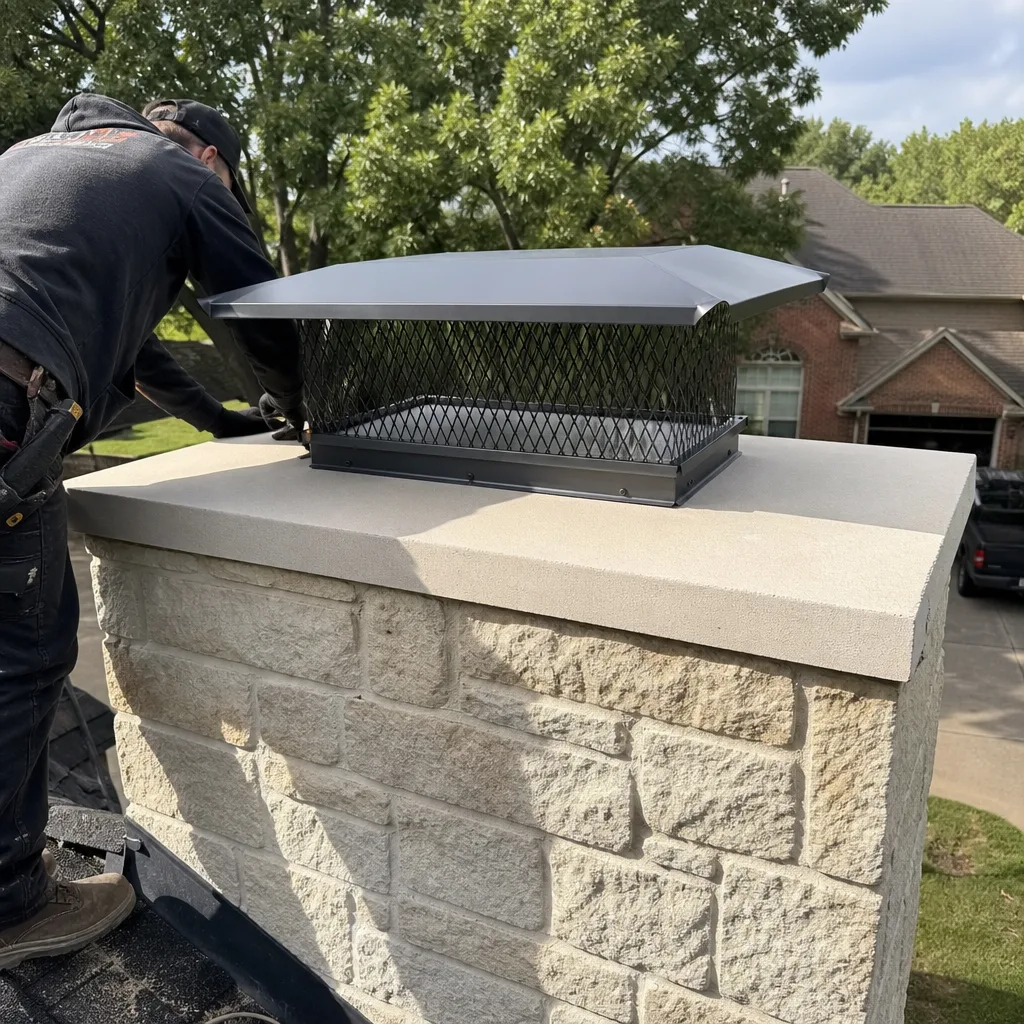
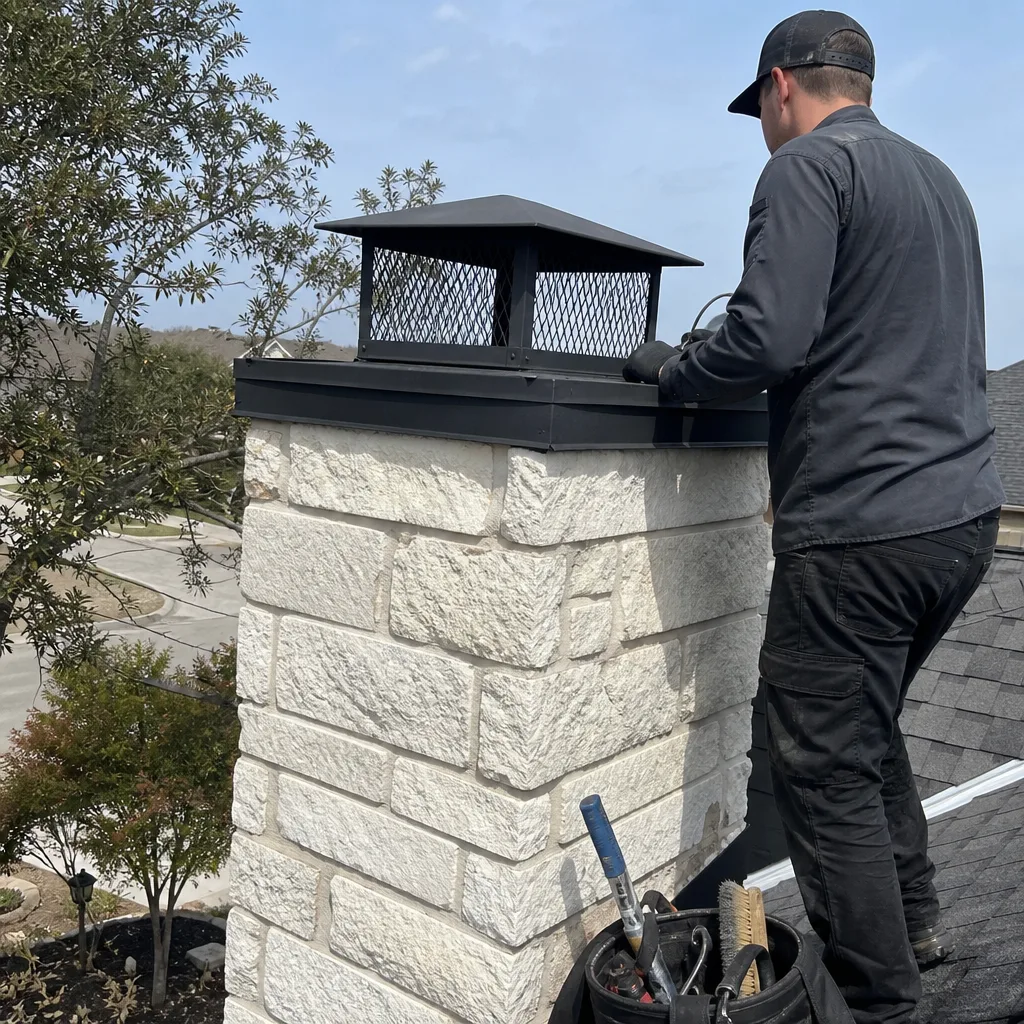
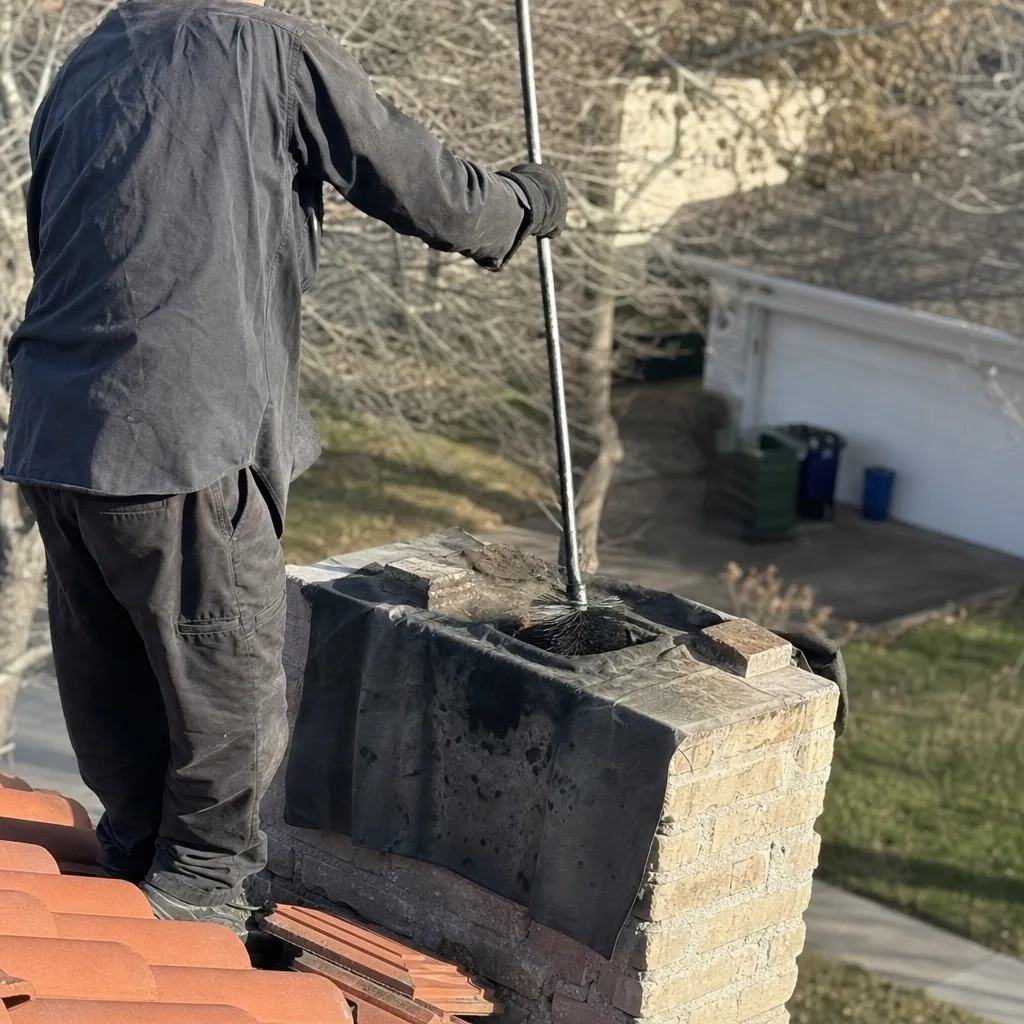
- Exterior cap and crown debris removal. If you own a stable ladder, work gloves, and a wire brush, you can clear leaves, twigs, and wasp nests from a chimney cap. This is genuinely useful maintenance in McKinney, where our post-oak and cedar elm canopies drop material year-round, and spring storms drive debris into flues across Craig Ranch and Tucker Hill. Check the crown (the concrete slab surrounding the flue tile) for obvious cracks while you’re up there. Hairline cracking is normal; gaps wider than a nickel warrant professional assessment.
What DIY cannot accomplish, regardless of skill or YouTube tutorials:
- Internal flue liner inspection for cracks, spalling, or mortar joint failure
- Smoke chamber parging assessment (the area above the damper where most chimney fires originate)
- Class II or III creosote removal (glazed or tar-like deposits require rotary chains or chemical treatment)
- Combustion gas analysis or draft pressure measurement
- Documentation that satisfies NFPA 211, home inspectors, or insurance adjusters
The equipment gap is real. A proper chimney sweep requires poly or fiberglass rods (not the cheap steel ones that can separate in the flue), brushes sized to your exact flue dimension, a high-capacity HEPA vacuum with triple filtration, drop cloths that actually seal to flooring, and respiratory protection rated for crystalline silica and wood tar exposure. The brush-and-rod kits sold at hardware stores are sized for “standard” flues - but McKinney homes built from 1985 to 2010 often have offset flue tiles, oval liners, or factory-built metal chimneys that need specialized heads. We’ve retrieved broken hardware-store rods from flues in Eldorado Heights and Trinity Falls more than once.
What You Literally Cannot See Without Professional Equipment
This is where the DIY conversation shifts from capability to consequence. The conditions that cause chimney fires and carbon monoxide intrusion are almost entirely invisible to the naked eye. You can have a clean-looking firebox, a brush that reached the top, and still harbor the defects that matter.
Here are the specific conditions we document on camera in McKinney homes every week:
Hairline flue tile cracks. Clay flue tiles expand and contract with heating cycles. Over 15 to 25 years, radial cracks develop that are 0.5 to 2 millimeters wide - too narrow to see from the firebox opening, invisible from the roof, and undetectable with a flashlight on a mirror. These cracks allow combustion gases to escape the flue and contact surrounding framing. In a two-story home in McKinney’s newer developments like Frisco Ranch or Spicewood at Craig Ranch, that framing is often engineered lumber with faster flame spread characteristics than old-growth dimensional lumber. The camera finds these cracks by looking straight at the tile surface with LED illumination; no other method works.
Mortar joint failure at elbows and offsets. Many McKinney homes, especially those built during the 1990s and 2000s construction boom, have flues with 30-degree offsets to avoid structural elements. The mortar at these joints erodes faster than straight vertical sections because creosote and condensation pool at the turn. A brush passing through feels normal - the bristles don’t detect missing mortar. But the resulting gap allows flames and hot gases to impinge on the chimney structure. We’ve found failed offset joints in homes throughout Westridge and Malone Heights where the homeowner had “cleaned the chimney every year” with a hardware-store brush.
Smoke shelf and smoke chamber obstructions. The smoke chamber is the inverted funnel above the damper that funnels smoke into the flue. NFPA 211 requires this area to be parge-coated smooth to reduce turbulence and creosote accumulation. In McKinney, we regularly find unparge-coated smoke chambers with corbelled brick that creates ledges for creosote buildup - sometimes 2 to 4 inches thick. A homeowner brushing the firebox has no visibility into this area. The camera does. More critically, we find bird nesting material, construction debris (especially in homes built 2005-2015), and in one memorable case in Providence Village, a complete squirrel skeleton that had been there since the home’s construction in 2012.
Hidden moisture damage from wind-driven rain. McKinney’s spring storm pattern - brief, intense, often with horizontal rain - drives water into chimney systems at the crown, flashing, and cap junctions. The damage manifests inside the flue as efflorescence (white mineral deposits), spalling tile (surface flaking), and rusted metal liners. None of this is visible from the firebox without a camera. By the time a homeowner notices water (stains on the ceiling, musty smell, deteriorating firebrick), the structural damage is typically $2,000 to $6,000 to repair. Early camera detection catches it at the crown-sealing stage - usually $400 to $800.
The equipment that finds these conditions isn’t available for consumer rental. Our chimney-scan camera systems run $8,000 to $15,000, with LED arrays, articulating heads, and 120-foot cable runs. The images are timestamped, GPS-tagged, and archived. That’s not gadgetry for its own sake. It’s the documentation standard that became Clause 4 of the Haven Standard in 2009, and it’s what separates a cleaning from a verifiable inspection.
The Documentation Divide: Why Insurers Care More Than You Think
Here’s the thesis of this guide, restated: the physical act of removing creosote is not the valuable service. The documentation is.
When a chimney fire occurs in McKinney - and we respond to several each winter, usually in homes that “hadn’t had a problem in years” - the insurance adjuster’s first request is not “when did you last clean it?” It’s “do you have a documented inspection showing the liner was intact before the fire?” Without that documentation, the claim enters a gray zone. The insurer may deny based on “failure to maintain,” “pre-existing defect,” or “unverified system condition.” We’ve seen it happen.
A professional Chimney Cleaning & Sweep in McKinney produces three outputs that DIY cannot replicate:
- Timestamped camera images. Every foot of the flue liner, smoke chamber, firebox, and exterior crown is photographed with metadata recording date, time, technician, and equipment calibration. These images are archived and retrievable. If a fire occurs in December 2026, we can produce the November 2025 inspection record with images showing liner condition at that time. Clause 4 of the Haven Standard requires this archive; we’ve maintained it since 2009.
- Written condition assessment. Not a checklist - a narrative report describing what was found, where, and what it means for system operation. “Flue tile at course 8 exhibits radial cracking 1.2mm wide, allowing gas migration. Recommend HeatShield cerfractory sealant application or liner replacement per scope attached.” This is the language insurers and home inspectors understand. It names the defect, locates it, and prescribes the remedy with material specification.
- Transferable warranty and liability. Our 365-Day Done Right Promise is a written warranty stamped on every job. If the work isn’t right, we make it right. More importantly for home sellers, this documentation transfers to the buyer and satisfies the chimney inspection contingency that McKinney real estate agents now routinely include. A DIY cleaning has no warranty, no named liability, and no transferability. When a buyer’s inspector asks for “proof of recent professional service,” a receipt for a brush kit doesn’t qualify.
The McKinney market makes this especially relevant. Home values in our core zip codes (75070, 75071, 75072) have appreciated 40 to 60 percent since 2020. Buyers are vigilant about documentation gaps. A seller who cleaned their own chimney annually for a decade has no paper trail for the buyer’s inspector. A seller with Level 2 inspection records from 2019, 2021, 2023, and 2025 has a documented maintenance history that supports asking price and reduces negotiation friction.
We offer a Free Second Opinion on any written estimate for this reason. If another company has provided documentation, we’ll review it against what our camera finds. Often the gaps are instructive.
McKinney-Specific Scenarios: When DIY Makes Sense and When It Doesn’t
McKinney’s housing stock, climate, and market conditions create specific scenarios where DIY maintenance is reasonable and others where it introduces unacceptable risk. For a full look at timing your maintenance through the year, see our Seasonal Chimney Cleaning Care for McKinney: Year-Round Homeowner’s Guide. We’ll be direct about both.
Scenarios Where DIY Is Reasonable
- Annual gas fireplace glass cleaning. Direct-vent and B-vent gas fireplaces accumulate white film on glass from combustion byproducts. This is normal maintenance, safely handled with manufacturer-approved cleaner and a soft cloth. No flue access required. Most McKinney homes with gas logs in Viridian or Trinity Falls fall here.
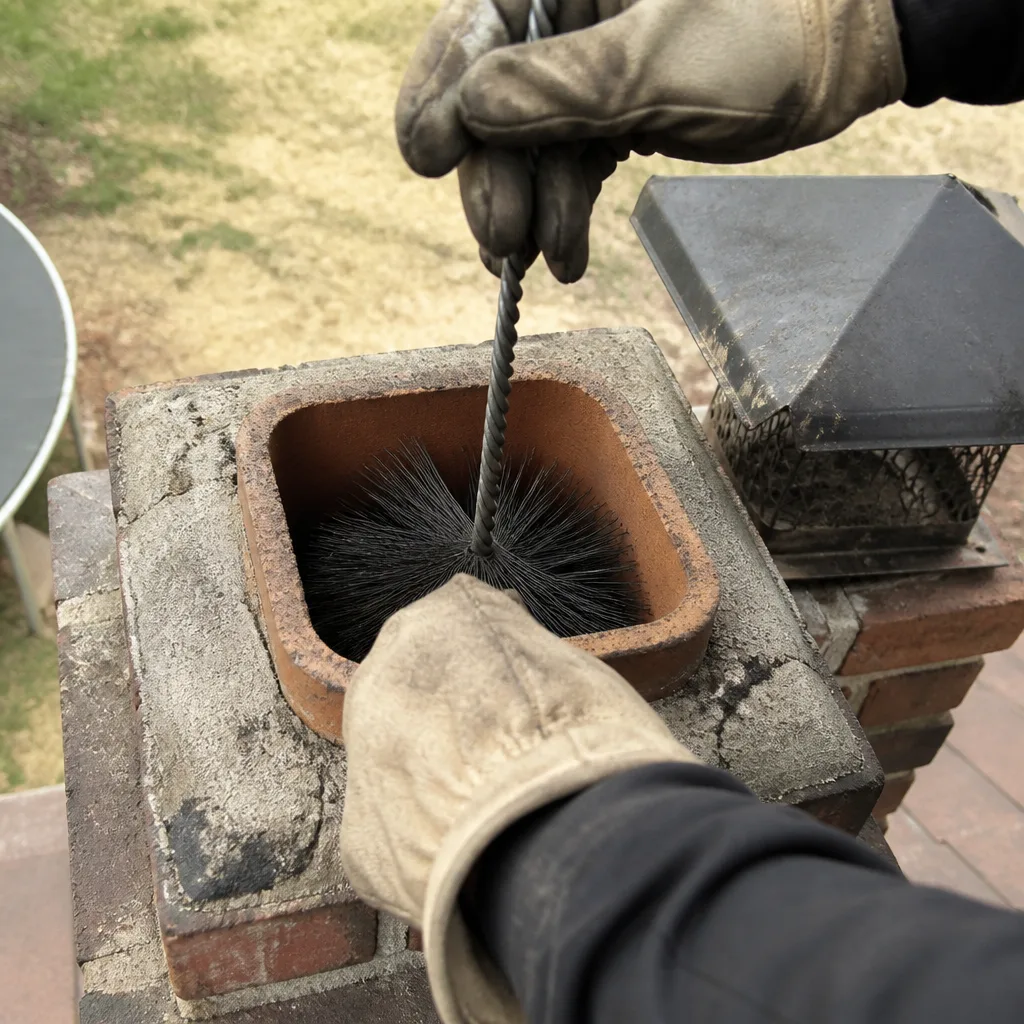
- Cap debris removal after storms. Our March through May storm season deposits leaves, twigs, and occasionally hail-damaged cap screens. A homeowner with a stable ladder and work gloves can clear this. Take a photo before and after for your records.
- Firebox ash cleanup between burns. Maintain 1 inch of ash bed for insulation, remove excess. Use metal containers with tight lids; alkaline ash can ignite paper or cardboard if stored improperly. We’ve responded to garage fires in McKinney from ash stored in plastic bins.
- Visual crown check from ground or roof. Look for obvious deterioration, missing cap, or animal activity. Document with date-stamped photos. This isn’t inspection, but it’s better than nothing.
Scenarios Where DIY Introduces Unacceptable Risk
- Post-storm inspection after hail or wind damage. McKinney’s 2023 and 2024 spring storms caused widespread roof and chimney damage. A homeowner cannot assess flashing integrity, crown cracking patterns, or hidden moisture intrusion without camera access. We found $12,000 in combined damage in a Stonebridge Ranch home where the owner had “checked the chimney from the roof” and missed cracked flue tiles caused by hail vibration.
- Pre-sale documentation. McKinney’s competitive seller’s market means inspection contingencies are tight - often 7 to 10 days. A DIY cleaning with no documentation forces the buyer’s inspector to find everything from scratch. Professional service with archived records lets you disclose proactively and defend your price.
- Any system not used in over two years. Unused chimneys deteriorate faster than active ones because there’s no drying heat cycle. Moisture accumulates, freeze-thaw cycles damage masonry, and animals colonize. The first fire in a long-dormant system is the highest-risk scenario. Camera inspection is mandatory before use.
- Wood-burning systems with unknown history. Bought a McKinney home built 1995-2010? The flue liner may be uninspected since construction. The previous owner’s “regular cleaning” may have been surface-only. Our camera finds the real condition.
- Systems with prior chimney fire. Even a “small” chimney fire (sounds like a freight train, dense smoke, hot exterior masonry) causes liner damage that’s invisible without inspection. Using the system again without professional assessment risks a second, more severe fire.
The McKinney climate amplifies certain risks. Our clay soils create foundation movement that stresses chimney structures. Our temperature swings - 30°F mornings to 70°F afternoons in winter - accelerate thermal cycling of masonry. Our hard water produces efflorescence at twice the rate seen in East Texas. These aren’t abstract concerns; they’re the specific conditions we document in Chimney Repair in McKinney estimates every week.
The True Cost Comparison: Equipment vs. Professional Service
Let’s put actual numbers on the table. The DIY chimney cleaning content online typically compares a $20 brush to a $200 service call and declares victory. That’s not an honest accounting - our Chimney Cleaning Cost Breakdown: The McKinney Homeowner’s Reference for 2026 covers what professional service actually includes.
Equipment a DIYer needs to do the job correctly:
| Item | Purpose | Approximate Cost |
|---|---|---|
| Poly/fiberglass rod set, 30+ feet | Reach full flue length without separation risk | $80-$140 |
| Brush heads (multiple sizes) | Match flue tile dimension exactly | $25-$45 each |
| HEPA vacuum, triple filtration | Contain fine particulate, protect respiratory health | $300-$600 |
| Drop cloths, sealing tape | Protect flooring and HVAC from soot migration | $40-$80 |
| Respiratory protection (P100 or better) | Filter crystalline silica and wood tar | $30-$60 |
| Inspection mirror and high-output flashlight | Visual assessment of accessible areas | $40-$70 |
| Ladder stabilizer and roof safety gear | Safe cap and crown access | $100-$200 |
| Total initial investment | $615-$1,195 |
This assumes you buy correctly the first time. Most homeowners buy a $35 brush-and-rod kit, discover it doesn’t reach or fit, then buy again. The HEPA vacuum is non-negotiable - standard shop vacuums expel respirable particles through the exhaust. We’ve tested this with particle counters; the difference is 50-fold.
Against this, Level Two Chimney McKinney home service pricing for a documented Level 2 inspection and sweep in the McKinney market runs $249-$389 for standard masonry fireplaces, depending on flue count, accessibility, and creosote condition. This includes:
- NFPA 211 Level 2 camera-scan inspection
- Full sweep with professional-grade equipment
- Timestamped photo record archived under Haven Standard Clause 4
- Written condition assessment and scope of any needed repairs
- Written price before any additional work begins
- 365-Day Done Right Promise warranty
The honest math: if you own one fireplace and plan to stay in your McKinney home 5+ years, professional service costs less than equipping yourself correctly, and you receive documentation you cannot generate. If you own multiple fireplaces or rental properties, the equipment investment amortizes better - but you still lack the inspection documentation that matters for liability and resale.
Materials matter in repair scenarios too. When we specify DuraFlex liners, HeatShield cerfractory sealant, or Gelco caps, we’re sourcing through Haven’s buying network to keep customer prices honest. A homeowner buying retail pays 30 to 50 percent more for the same materials, without installation expertise or warranty backing.
Safety Realities: What the NFPA 211 Standard Actually Requires
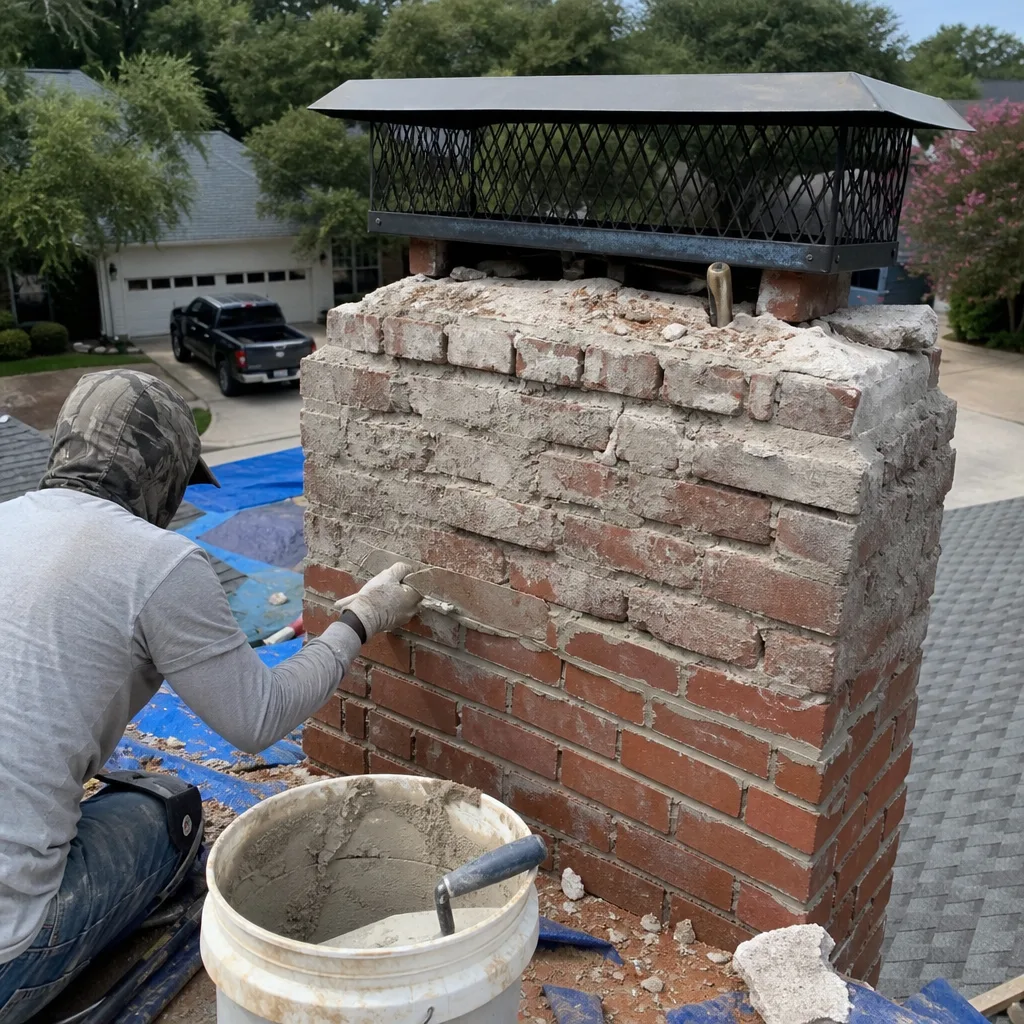
The National Fire Protection Association Standard 211 is the authoritative reference for chimney safety in the United States. Texas has not adopted a state-specific amendment, so the base standard applies in McKinney. Here’s what it actually says about inspection levels, and why it matters for your DIY decision.
Level 1 Inspection: Visual examination of readily accessible portions of the chimney exterior, interior, and connecting appliances. No tools required, no obstruction of interior finishes. This is what a homeowner can approximate with a flashlight and mirror - limited, surface-only, and explicitly not sufficient when conditions of use have changed or when a real estate transaction is involved.
Level 2 Inspection: Required upon sale or transfer of property, after chimney fire or malfunction, or when changes are made to the system. Includes Level 1 scope plus accessible attics, crawl spaces, and basements, and video scanning or other inspection of interior flue surfaces. This is the standard we apply on every visit, regardless of trigger conditions, because surface inspection misses the defects that matter.
Level 3 Inspection: Required when concealed hazards are suspected. Includes demolition of building components to access hidden areas. We perform these when camera inspection reveals anomalies requiring direct examination.
The safety caveat that matters: chimney fires reach 2,000°F and can crack flue tiles in under 20 minutes. Carbon monoxide, produced by incomplete combustion in a damaged or obstructed flue, is odorless and lethal at 400 ppm sustained exposure. These are not hypothetical risks. McKinney Fire Department responds to chimney fires annually, typically in January when systems see first heavy use after warm spells. The homeowners involved invariably believed their system was “fine” because it looked clean.
We do not provide step-by-step DIY instructions for flue access, liner assessment, or creosote removal because these activities involve genuine hazards: working at height, respiratory exposure to carcinogenic compounds, and the risk of damaging a system you cannot see completely. A real expert flags the danger and recommends trained evaluation. That’s what we’re doing here.
Common Mistakes to Avoid
- Using a standard shop vacuum for ash cleanup. The fine particles pass through standard filters and recirculate through your home. We’ve cleaned white film from McKinney living rooms where homeowners learned this the hard way. Only HEPA-rated vacuums with sealed systems are appropriate.
- Assuming a clean firebox means a clean flue. The firebox is the most visible and easiest-to-clean area. Creosote accumulates in the cooler upper flue and smoke chamber, invisible from below. A pristine firebox tells you nothing about liner condition.
- Using the wrong brush size or material. A brush too small doesn’t contact tile surfaces; too large can lodge in the flue or damage liner joints. Steel brushes on clay tile cause scoring that accelerates creosote adhesion. We size brushes with a tape measure before every job.
- Ignoring McKinney’s freeze-thaw cycle. Our winter temperature swings cause moisture in masonry to expand and contract. A homeowner who cleans in October and ignores the crown until spring may find significant deterioration by March. Annual professional inspection catches this progression.
- Documenting nothing. Photos on your phone with no date stamp, no location context, and no technical assessment are not documentation. They’re souvenirs. When an insurer or buyer’s inspector asks for proof of maintenance, they want professional records.
- Sweeping a gas fireplace flue without understanding the vent type. Direct-vent systems have sealed combustion and don’t require traditional sweeping. B-vent systems do. Confusing the two can damage components or create false confidence. Fireplace Services in McKinney assessment clarifies your system type.
- Waiting for visible problems before acting. By the time you see staining, smell smoke indoors, or hear chimney fire sounds, damage is established. Preventive inspection is always less expensive than reactive repair.
When to Call a Professional
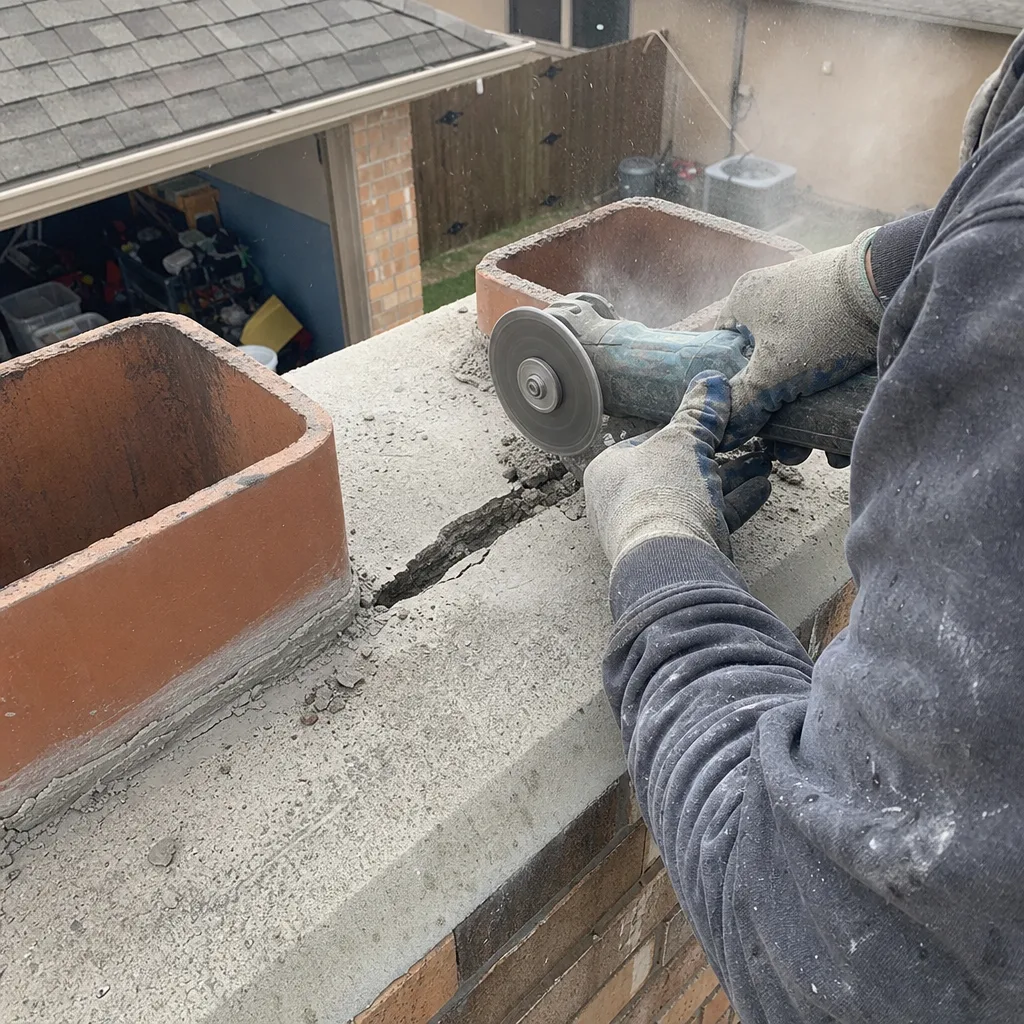
Call a professional when documentation matters: before selling, after buying, following any storm with wind or hail, after any chimney fire or near-miss, and before first use of any system dormant over two years. Call when you cannot see the full flue interior, when creosote is glazed or tar-like, or when any component shows damage you don’t fully understand.
Level Two Chimney McKinney offers free estimates in McKinney. Every estimate includes a written price, written scope, and written warranty before any work begins - Haven Standard Clause 1, H.A.V.E.N. “Have it in writing.” Our technicians are background-checked, uniformed, and assigned by name; you’ll receive a text when yours is en route. Live phone support runs 24 hours a day, 7 days a week at (469) 429-2623.
Frequently Asked Questions
A documented Level 2 inspection and sweep in McKinney typically runs $249-$389 for standard masonry fireplaces, depending on flue count, accessibility, and creosote condition. This includes camera-scan inspection, professional sweep, timestamped photo record, written assessment, and 365-Day Done Right Promise warranty. Call (469) 429-2623 for an exact quote - estimates are free.
Yes. Texas does not require licensure for chimney sweeping, and homeowners may perform their own maintenance. However, DIY cleaning does not produce the documented inspection record that insurers, home inspectors, or buyers may require to verify system safety. The legality of doing the work differs from the sufficiency of the documentation.
NFPA 211 recommends annual inspection for all chimney systems, with cleaning frequency determined by use and fuel type. Wood-burning systems used regularly during McKinney’s heating season (typically November through March) generally need annual sweeping. Gas systems need less frequent cleaning but still require annual inspection for vent integrity, cap condition, and moisture damage from our spring storms. Systems with heavy use or poor wood quality (unseasoned oak or elm, common in our area) may need mid-season attention.
Clay tile flues can last 50+ years if undamaged and properly maintained. Replacement becomes necessary when inspection reveals cracked, spalled, or missing tiles; significant mortar joint failure; or gaps that allow gas migration. We don’t recommend replacement without camera evidence you can see for yourself. Our Free Second Opinion on any written estimate lets you compare documentation before deciding. Some conditions can be addressed with HeatShield cerfractory sealant rather than full liner replacement.
Three outcomes, in order of probability: progressive creosote accumulation increasing fire risk; moisture intrusion causing masonry and liner deterioration; and eventual system failure requiring major repair or replacement. In McKinney’s market, skipped maintenance also means no documentation for resale, which buyers and inspectors increasingly demand. The cost of deferred maintenance typically exceeds preventive service by 5 to 10 times.
A sweep removes combustible deposits from the flue and firebox. An inspection evaluates system condition and safety. They are distinct services, though we perform both together on every visit. A sweep without inspection is cleaning without knowing what you’re cleaning; an inspection without sweep leaves identified hazards in place. Clause 4 of the Haven Standard requires the photo record that documents both.
Chemical creosote modifiers exist and can reduce light, flaky deposits when used correctly. They do not remove established buildup, do not inspect for liner damage, and do not produce documentation. In McKinney, where Class II and III creosote are common due to our humid shoulder seasons and frequent use of marginal firewood, chemical treatment alone is insufficient. We use chemical pretreatment as an adjunct to mechanical removal, not a replacement.
The Bottom Line
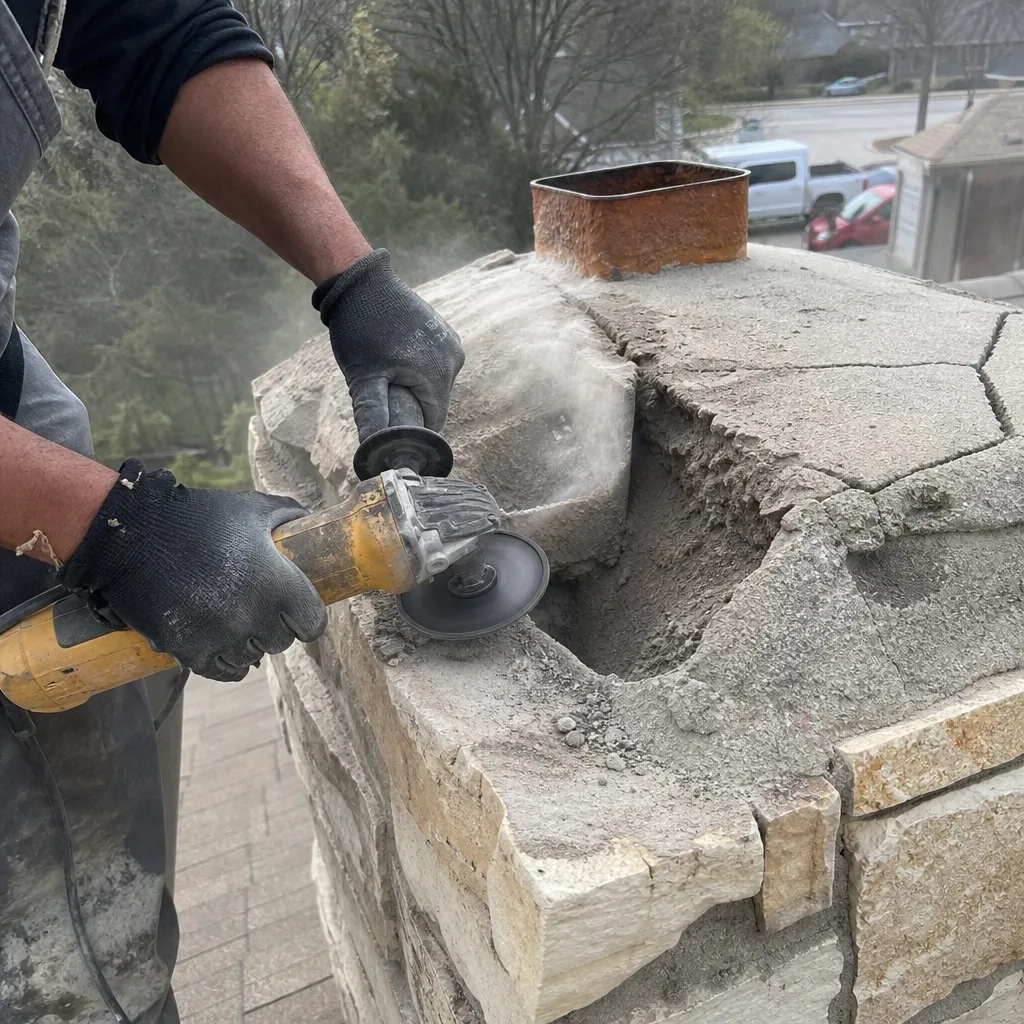
DIY chimney maintenance in McKinney has its place: gas glass cleaning, cap debris removal, and firebox ash management are reasonable homeowner tasks. If you’re weighing whether to hire help, read How to Hire a Chimney Cleaning Contractor in McKinney: A Step-by-Step Guide. But the work that matters for safety, insurance, and property value requires equipment you cannot buy and documentation you cannot generate yourself. The real cost of professional service is not the sweep - it’s the camera record, written assessment, and warranty that protect you when questions arise. Since 2009, we’ve completed more than 38,000 chimney inspections and cleanings, every one with a written price before work started and a documented record when it was done. That’s the standard we apply in McKinney, and it’s the standard your home deserves.
Call (469) 429-2623 for a free estimate. We’ll provide a written price, written scope, and written warranty before any work begins. Live phone support, 24 hours a day, 7 days a week.
Written by Corrine Halstead, Owner at Level Two Chimney McKinney, serving McKinney since 2009.